Sgt. Charles “Chuck” Mawhinney spent almost a year and a half in Vietnam, but when he returned home to Oregon in 1969, he kept the details of his service a secret. No one outside a small circle of Marines he served with knew the truth: he was the deadliest sniper in Marine Corps history.
Mawhinney’s story went untold for two decades, but in 1991, friend and former Marine sniper Joseph Ward published a book that credited Mawhinney with 101 confirmed kills, a new record.
Ward’s book triggered an investigation into Marine Corps records, and it was found that the number he reported was incorrect. It turns out that Mawhinney actually had 103 confirmed kills. He also had another 216 “probable” kills.
With the release of Ward’s “Dear Mom: A Sniper’s Vietnam” and the end of Mawhinney’s quiet life of anonymity, this outstanding sharpshooter came out of the shadows and shared parts of his story publicly.
In one particularly intense engagement, Mawhinney put 16 bullets in 16 enemy troops in just thirty seconds, and he did it in the dark.
“I got 16 rounds off that night as fast as I could fire the weapon,” Mawhinney said in an interview for a documentary on Marine scout snipers. “Every one of them were headshots, dead center. I could see the bodies floating down the river.”
Vietnam, as it was for many, was hell for Mawhinney, but he extended his tour of duty because he knew he had the abilities to keep his fellow Marines alive.
One of the things that haunted Mawhinney after Vietnam was an enemy soldier that got away after an armorer had made adjustments to his rifle. He fired off multiple shots. All of them missed.
“It’s one of the few things that bother me about Vietnam,” he previously told The Los Angeles Times. “I can’t help thinking about how many people that he may have killed later, how many of my friends, how many Marines.”
Mawhinney left Vietnam after being diagnosed with combat fatigue. He is still alive, and his M40 rifle is on display in the National Museum of the Marine Corps.
The only US military sniper with more confirmed kills than Mawhinney in Vietnam was Army sharpshooter Adelbert Waldron with 109 confirmed kills.
Like many of the men going over to Vietnam to serve their country, young women from all over the nation volunteered to serve as nurses in the hospitals and medical facilities in South Vietnam. These women volunteered for a variety of reasons: to serve their country, to help the service men who were wounded, to receive training and an education, to further their military careers, to prove themselves or just to have an adventure. The nurses served in the hospital ships of the Navy, the airlift helicopters and airplanes of the Air Force and the hospitals and field hospitals of the Army. They arrived in Vietnam with various levels of nursing experience, from newcomers to the field with barley six months of Nursing under their belts to experienced veterans of twenty plus years. Usually the more confident and experienced the nurse, the better they were able to cope with the stress and the sheer number of casualties they treated on a daily basis.
The Vietnam War was the first major conflict to use the helicopter to transport wounded quickly to medical facilities; sometimes a man would be in the hospital receiving medical care barely half an hour after he had been wounded. This new medevac system saved the lives of thousands of men who in previous conflicts would have died in the battlefield waiting for medical assistance. Because of this phenomenon, Vietnam nurses were faced with more patients and more severely wounded men than they had seen in previous conflicts. These nurses were required to make quick decisions on who was treated first and what type of treatment they would receive; a much more autonomous state than nursing in the states where they were expected to follow a doctor’s orders and nothing more.
Combat nurses worked twelve hour shifts six days a week and when a mass casualty incident occurred, like a major battle, those twelve hour shifts could easily turn into twenty-four to thirty-six hour shifts. Nurses also volunteered their time in the communities around them, often going to the local orphanages or hospitals to offer the civilians their medical services or to teach classes on basic hygiene, first aid or even English. In addition, nurses had to deal with numerous emotions: stress from the amount of patients they had to serve, anger at seeing young men so horribly wounded and guilt at not being able to save all of the wounded men or make them whole again.
Despite the long hours and sometimes horrifying wounds these women had to face, many nurses found their service rewarding. They were able to serve their country and save and comfort the wounded men in their facilities. During the Vietnam War 98% of the men who were wounded and made it to the hospital survived. Nurses witnessed some truly miraculous events such as men recovering from their wounds or acts of true selflessness that are common during combat situations, and many nurses made close friends with their fellow coworkers some of whom still keep in contact into the present day.
Seductive songs. Soft sounds. Sex symbol. Sinatra.
No, not that one! Nancy Sinatra.
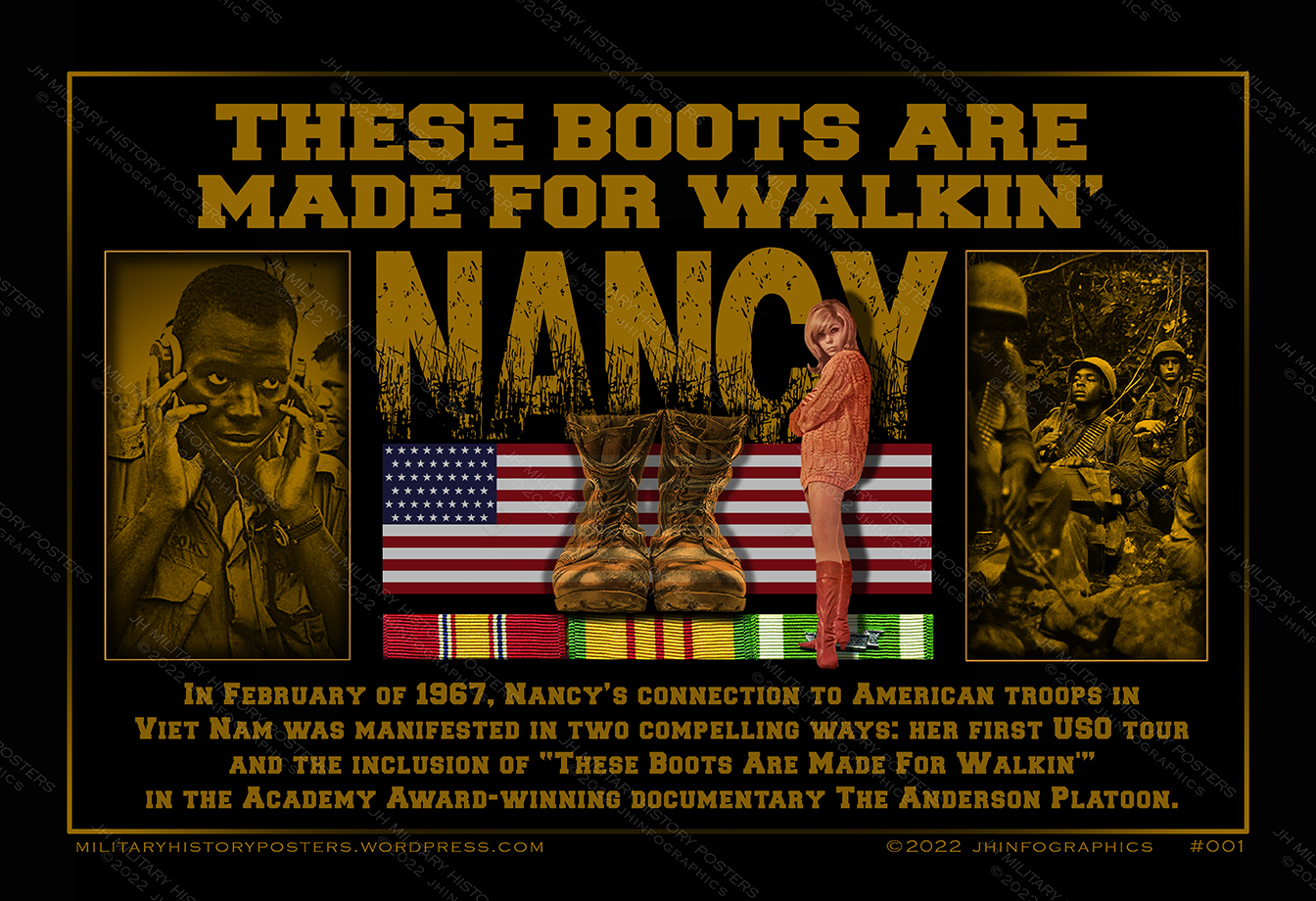
Any discussion of Nancy Sinatra logically begins with the song turned anthem for the women’s lib set. Undeniably, Nancy Sinatra secured her place in popular culture with her #1 song — These Boots Are Made For Walkin’ in 1966.
She traveled a journey in those boots, before and after her signature song. It’s a journey worth exploring.
From her only #1 song to her recreation of it two decades on China Beach, an ABC prime time show in the late 1980s and early 1990s set in an American army hospital during the Vietnam War.
From her appearance on the historic 1960 television special Welcome Back, Elvis hosted by her father, Frank Sinatra, to welcome Elvis Presley back from his two-year stint in the Army to her co-starring position with Elvis nearly a decade later in the 1968 film Speedway.
From the innocent girl who shyly appeared on her father’s television show, The Frank Sinatra Show, to the older and bolder woman who graced the cover of Playboy in her mid-50s.
Throughout her career, Nancy Sinatra has left some pretty big bootprints on the show business landscape.
These Boots Are Made For Walkin’ spent one glorious week in February 1966 in the #1 position on the popular music chart. Lee Hazelwood wrote and produced the song, revealing his country & western leanings with the words and the beat, particularly if you eliminate the jazzy horn section.
More than two decades after reaching #1, Nancy Sinatra relived her triumph. She appeared as herself and sang Boots in the China Beach episode Chao Ong. It first aired on June 8, 1988 on ABC. Nancy’s appearance reinforced the show’s verisimilitude. Stanley Kubrick’s 1987 Vietnam War film Full Metal Jacket featured Boots on its soundtrack.
In real life, Nancy Sinatra performed for American troops in Vietnam, but not before doing some serious soul searching. An NBC press release dated April 1, 1968 quoted the vivacious singer on this subject. NBC distributed the press release to promote the repeat broadcast of Ms. Sinatra’s television special Movin’ With Nancy — it aired on NBC on April 15, 1968. The original broadcast occurred on December 11, 1967.
“I signed up to go on a public appearance tour. I became frightened and cancelled. I went home and cried hysterically. I used yoga to calm myself and analyze my feelings. I realized that I was suffering because of my decision not to go. I was sick. I went to Dad and said ‘I have to go.’ He said, ‘Then let’s work it out.’”
But Nancy Sinatra had a problem beyond second thoughts and cold feet. Her show needed a lot of rebuilding.
“The show I was going with had fallen apart, which had been part of the problem. Dad helped me put a new show together. We missed our place in San Francisco by 30 seconds. I wondered whether God was trying to tell me something.”
A clergyman saw Nancy and told her, I make that trip twice a month. You will get much more from it than you will give.
Nancy assimilated her Vietnam War tour into her performances when she returned to the United States.
The March 1, 1967 edition of Variety reviewed a performance on The Ed Sullivan Show, stating, “Of major interest was Nancy Sinatra, who had been making headway in entertainment orbits. Recently returned from Vietnam, Miss Sinatra showed a feeling as well as a sound in her two-part recital. In each instance, she was backed by heavy production, the first part was montaged with shots of her GI tour, and the second with honky-tonk atmosphere. She has enough to get by on her own.”
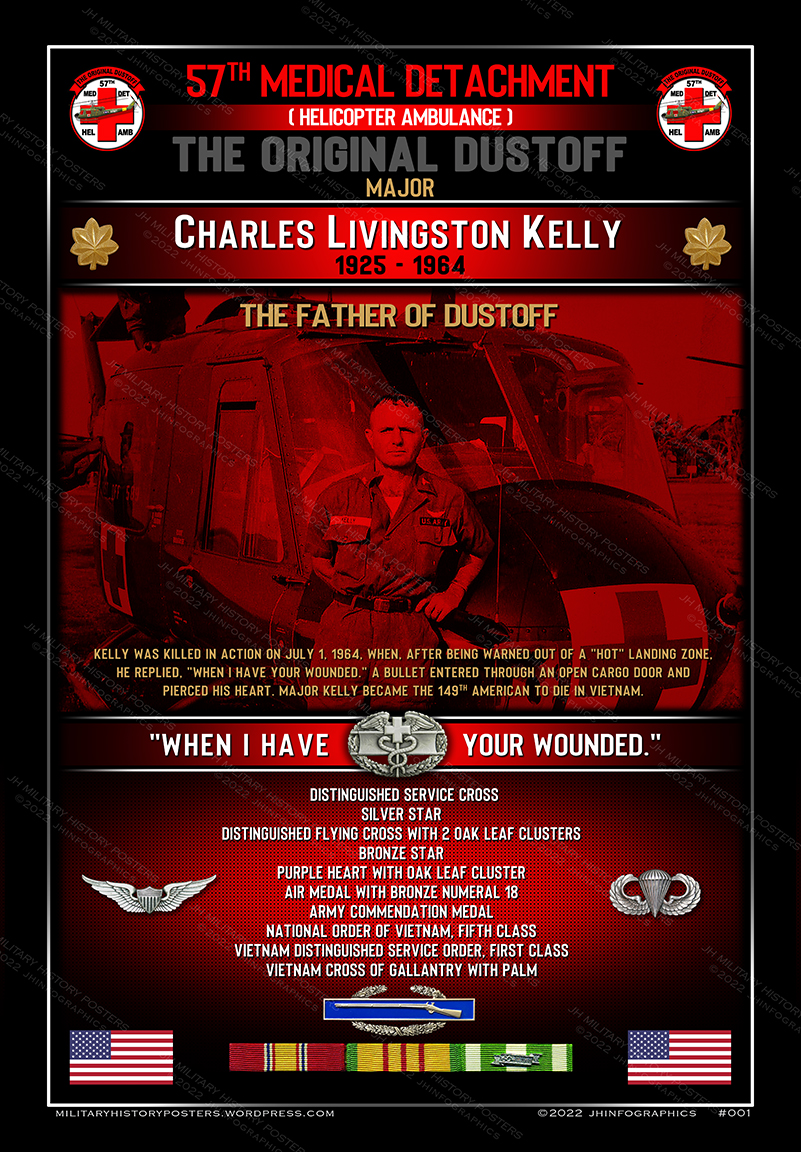
Major Charles L. Kelly was DUSTOFF and DUSTOFF was “Combat Kelly.” The two became synonymous in Vietnam in 1964. As commander of the 57th Medical Detachment (Helicopter Ambulance), Kelly assumed the call sign “DUSTOFF.”
His skill, aplomb, dedication, and daring soon made both famous throughout the Delta. The silence of many an outpost was broken by his radio draw, “…this is DUSTOFF. Just checking in to see if everything is okay.” And when there were wounded, in came Kelly “hell-bent for leather!” On 1 July 1964 Kelly approached a hot area to pick up wounded only to find the enemy waiting with a withering barrage of fire. Advised repeatedly to withdraw, he calmly replied to the ground element’s advisor, “When I have your wounded.” Moments later, he was killed by a single bullet. Kelly was dead but his “DUSTOFF” became the call sign for all aeromedical missions in Vietnam. “When I have your wounded” became the personal and collective credo of the gallant DUSTOFF pilots who followed him. Major Charles L. Kelly was inducted into the DUSTOFF Hall of Fame on 17 February 2001.
Members of the United States armed forces were held as prisoners of war (POWs) in significant numbers during the Vietnam War from 1964 to 1973. Unlike U.S. service members captured in World War II and the Korean War, who were mostly enlisted troops, the overwhelming majority of Vietnam-era POWs were officers, most of them Navy, Air Force, and Marine Corps airmen; a relatively small number of Army enlisted personnel were also captured, as well as one enlisted Navy seaman, Petty Officer Doug Hegdahl, who fell overboard from a naval vessel. Most U.S. prisoners were captured and held in North Vietnam by the People’s Army of Vietnam (PAVN); a much smaller number were captured in the south and held by the Việt Cộng (VC). A handful of U.S. civilians were also held captive during the war.
Thirteen prisons and prison camps were used to house U.S. prisoners in North Vietnam, the most widely known of which was Hỏa Lò Prison (nicknamed the “Hanoi Hilton”). The treatment and ultimate fate of U.S. prisoners of war in Vietnam became a subject of widespread concern in the United States, and hundreds of thousands of Americans wore POW bracelets with the name and capture date of imprisoned U.S. service members.
American POWs in North Vietnam were released in early 1973 as part of Operation Homecoming, the result of diplomatic negotiations concluding U.S. military involvement in Vietnam. On February 12, 1973, the first of 591 U.S. prisoners began to be repatriated, and return flights continued until late March. After Operation Homecoming, the U.S. still listed roughly 1,350 Americans as prisoners of war or missing in action and sought the return of roughly 1,200 Americans reported killed in action, but whose bodies were not recovered. These missing personnel would become the subject of the Vietnam War POW/MIA issue.
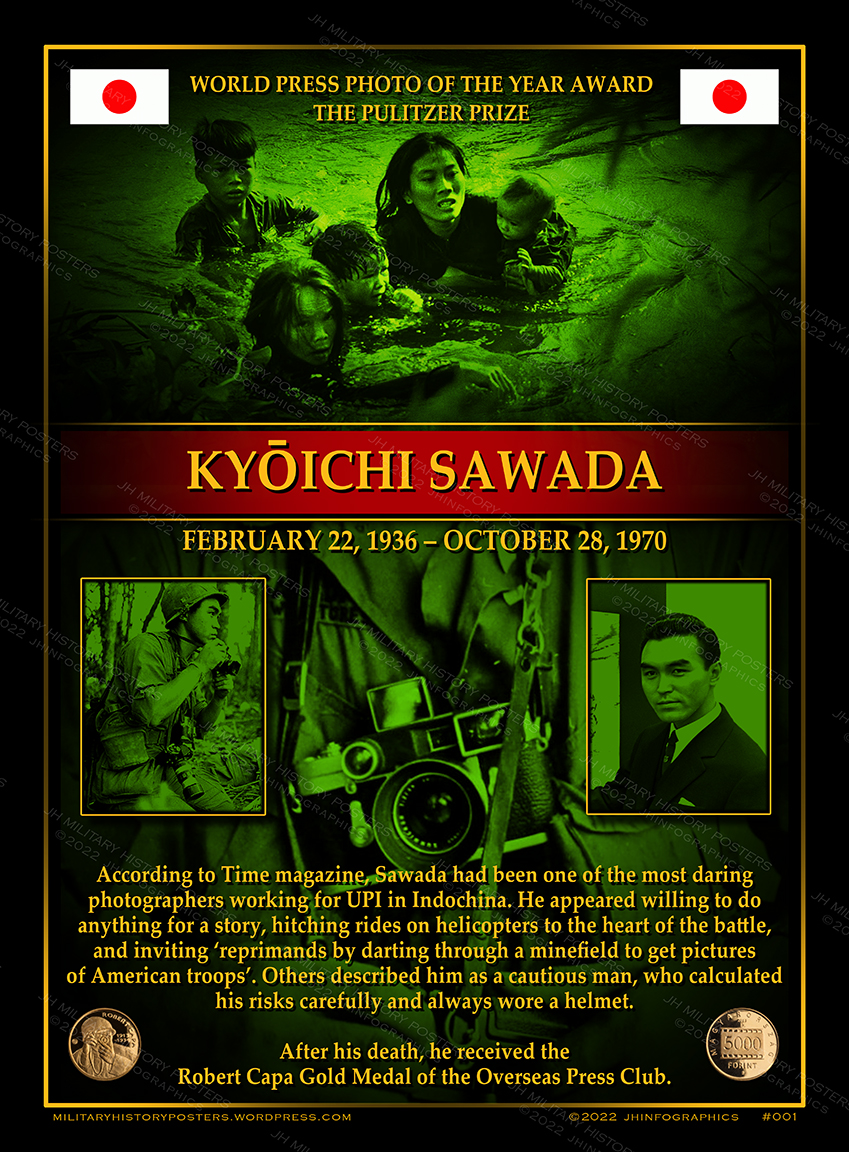
Kyōichi Sawada was a Japanese photographer with United Press International who received the 1966 Pulitzer Prize for Photography for his combat photography of the Vietnam War during 1965. Two of these photographs were selected as “World Press Photos of the Year” in 1965 and 1966. The 1965 photograph shows a Vietnamese mother and children wading across a river to escape a US bombing.
The iconic World Press award-winning photograph by Sawada shows an armored M113 with US soldiers dragging the dead body of a Vietcong child combattant (1966).
The famous 1966 photograph shows U.S soldiers of the 1st Infantry division dragging a dead Viet Cong fighter to a burial site behind their M113 armored personnel carrier, after he was killed in a fierce night attack by several Viet Cong battalions against Australian forces during the Battle of Long Tan on 18 August 1966.
He also documented the Battle of Hue in 1968, for example capturing an image of Lance Corporal Don Hammons immediately after being wounded by enemy fire; he died minutes later.
On October 28, 1970, Sawada and Frank Frosch, UPI Phnom Penh branch chief, were ambushed by unknown assailants and assassinated while returning to Phnom Penh by car from a news-gathering outing to Takéo Province. The bodies of the two men were found abandoned in a rice paddy near the road, riddled with bullet holes. No blood or bullet holes were found in their car, suggesting that they had been dragged from their vehicle and killed execution-style. There was no chance they had been mistaken for soldiers since they were driving in a civilian car and were wearing brightly colored civilian clothing.
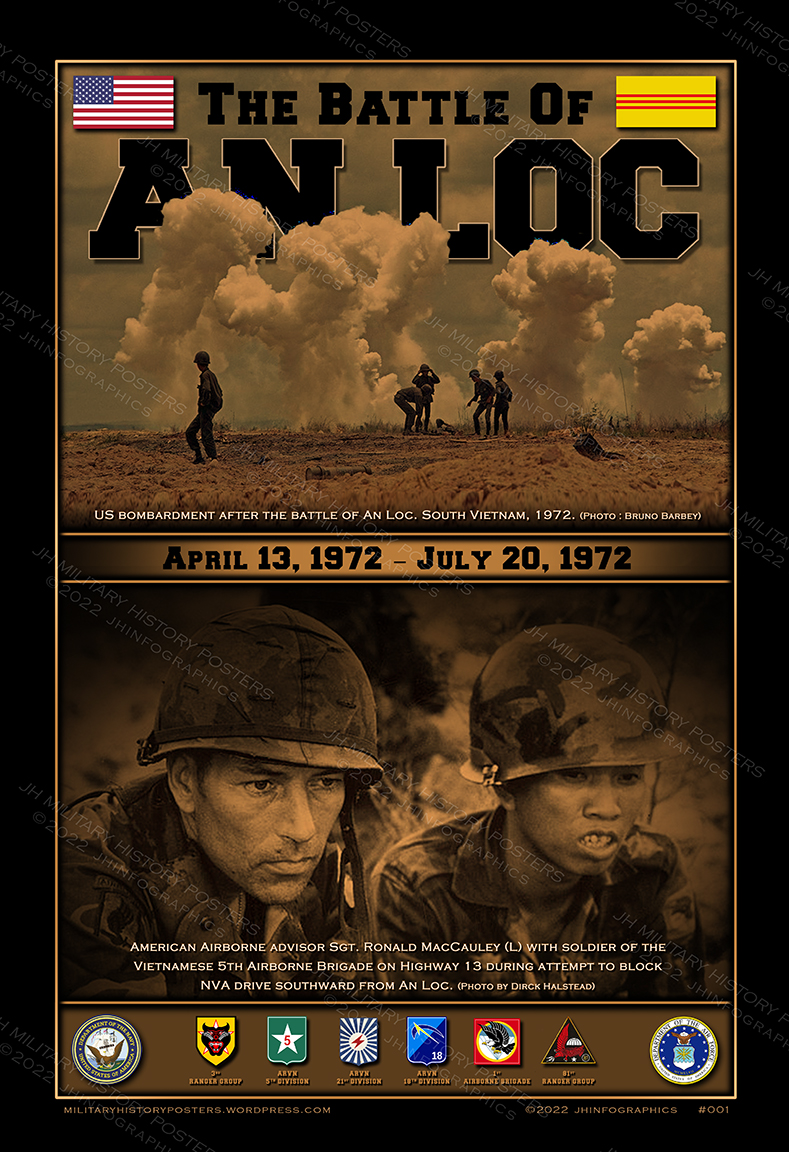
The Battle of An Lộc was a major battle of the Vietnam War that lasted for 66 days and culminated in a tactical victory for South Vietnam. The struggle for An Lộc in 1972 was an important battle of the war, as South Vietnamese forces halted the North Vietnamese advance towards Saigon.
An Lộc is the capital of Bình Phước Province located northwest of Military Region III. During North Vietnam’s Easter Offensive (known in Vietnam as the Nguyen Hue Offensive) of 1972, An Lộc was at the centre of People’s Army of Vietnam (PAVN) strategy, its location on Route QL-13 near Base Area 708 in Cambodia allowed safeguarding supplies based out of a “neutral” location in order to reduce exposure to U.S. bombing. To protect this critical area, the Army of the Republic of Vietnam (ARVN) had essentially a single division in Bình Phước Province, the 5th Division. During the battle, the 5th Division was outnumbered by a combined force consisting of three PAVN and Viet Cong divisions. This fighting which ensued became the most protracted conflict of the 1972 Easter Offensive.
On the same day that Lộc Ninh, a small town 20 miles (32 km) north of An Lộc on the border with Cambodia was assaulted, the PAVN 7th Division launched an attack on route QL-13 in an attempt to cut off An Lộc from Saigon. To control QL-13 was to control the road to Saigon, roughly 90 miles (140 km) to the south. This prevented resupply of ARVN forces in An Lộc battle.
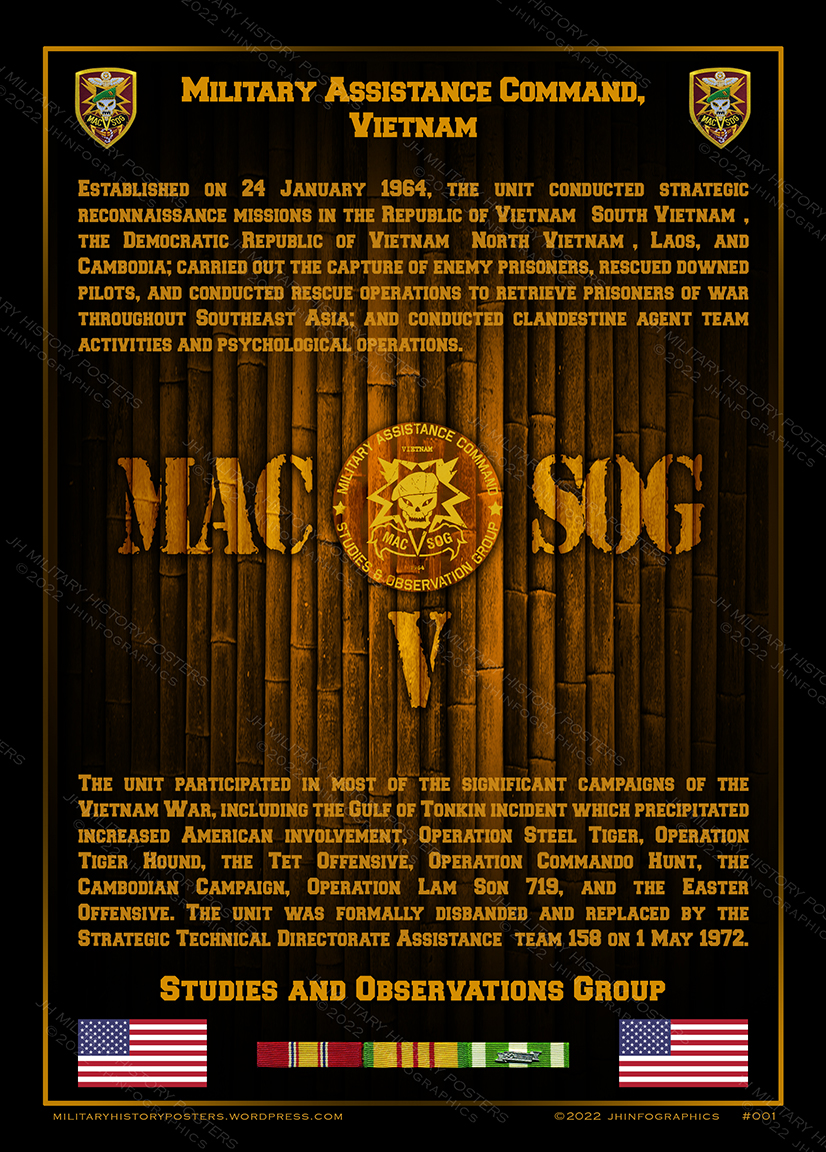
Military Assistance Command, Vietnam – Studies and Observations Group (MACV-SOG) was a highly classified, multi-service United States special operations unit which conducted covert unconventional warfare operations prior to and during the Vietnam War.
Established on 24 January 1964, it conducted strategic reconnaissance missions in the Republic of Vietnam (South Vietnam), the Democratic Republic of Vietnam (North Vietnam), Laos, and Cambodia; took enemy prisoners, rescued downed pilots, conducted rescue operations to retrieve prisoners of war throughout Southeast Asia, and conducted clandestine agent team activities and psychological operations.
The unit participated in most of the significant campaigns of the Vietnam War, including the Gulf of Tonkin incident which precipitated increased American involvement, Operation Steel Tiger, Operation Tiger Hound, the Tet Offensive, Operation Commando Hunt, the Cambodian Campaign, Operation Lam Son 719, and the Easter Offensive. The unit was downsized and renamed Strategic Technical Directorate Assistance Team 158 on 1 May 1972, to support the transfer of its work to the Strategic Technical Directorate of the Army of the Republic of Vietnam – part of the Vietnamization effort.
The United States Marine Corps War Memorial (Iwo Jima Memorial) is a national memorial located in Arlington County, Virginia, in the United States. The memorial was dedicated in 1954 to all Marines who have given their lives in defense of the United States since 1775. It is located in Arlington Ridge Park within the George Washington Memorial Parkway, near the Ord-Weitzel Gate to Arlington National Cemetery and the Netherlands Carillon. The memorial was turned over to the National Park Service in 1955.
The war memorial was inspired by the iconic 1945 photograph of six Marines raising a U.S. flag atop Mount Suribachi during the Battle of Iwo Jima in World War II taken by Associated Press combat photographer Joe Rosenthal. Upon first seeing the photograph, sculptor Felix de Weldon created a maquette for a sculpture based on the photo in a single weekend at Patuxent River Naval Air Station in Maryland, where he was serving in the Navy. He and architect Horace W. Peaslee designed the memorial. Their proposal was presented to Congress, but funding was not possible during the war. In 1947, a federal foundation was established to raise funds for the memorial.
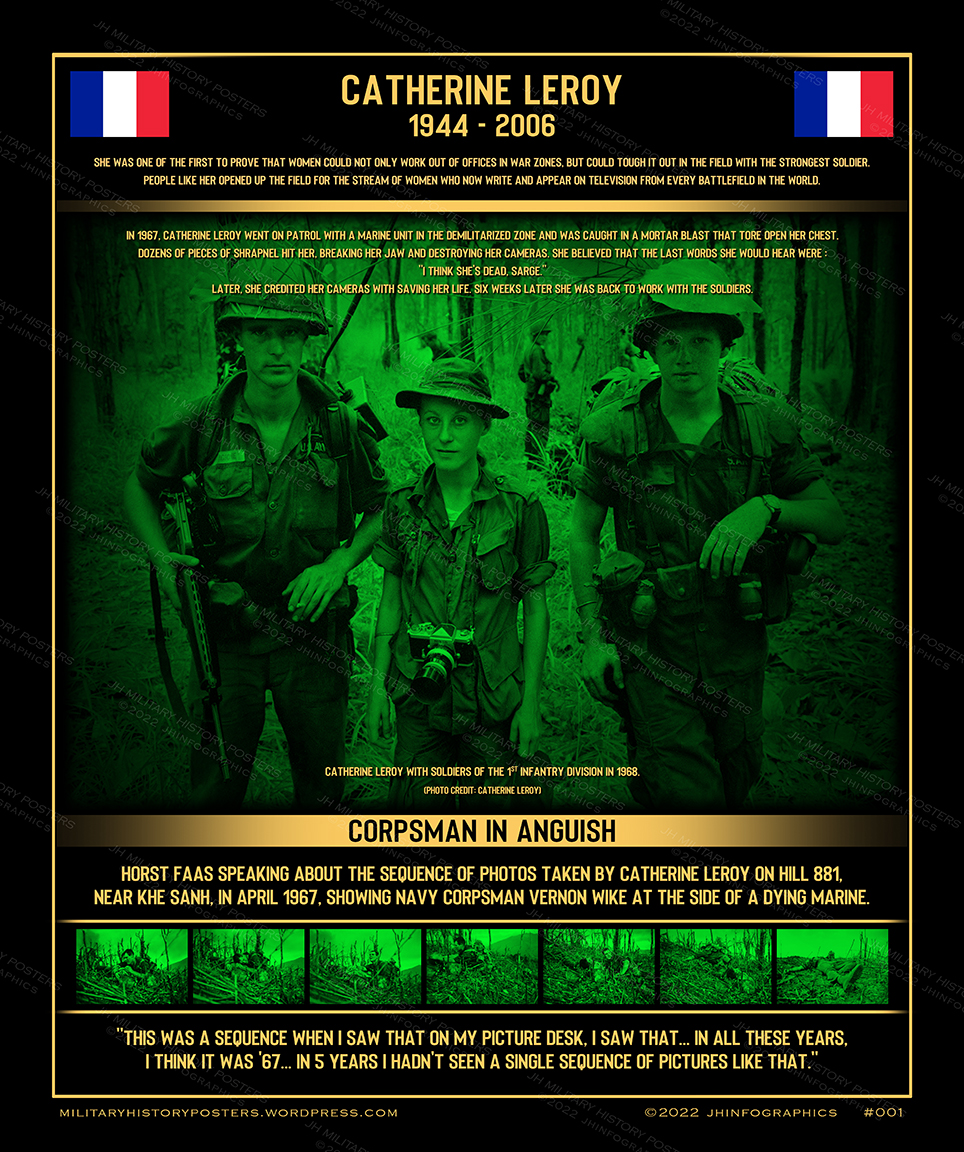
Probably the most famous picture taken by the French photographer Catherine Leroy, who has died of lung cancer aged 60, is a graphic image of a young American marine in Vietnam in 1967, his hand pressed to a fallen comrade’s chest, gazing upwards, mouth open in a gasp as he realises the man has died.
But the picture that perhaps shows her style better is of a gently smiling 12-year old Palestinian girl facing the camera in Beirut in 1982. She wears a headband that supports two glittery hearts. Her smile is so sweet that you do not notice – until the second or third glance – that her right arm has been blown off at the elbow by an Israeli shell, and ends in a black plastic stump.
This was what made Leroy, and other great war photographers like Don McCullin, so different from the herd of freelances who made good money – and reputations – in the wars of the second half of the 20th century. In a war the easiest subject to find is a bleeding corpse. The real genius is to take a picture of a living person, without a drop of blood showing, and record the suffering in a single human face.
Leroy was born in Paris, went to conservative Catholic high schools, studied music and thought she might become a classical pianist. But in 1966, aged 21, “I bought a one-way ticket to Saigon, and flew off with $150 and a Leica. I wanted to be a war photographer, but I had never heard a shot fired in anger.” On arrival, she did what every tyro did; she went to the Associated Press office, where the legendary photo editor Horst Fass listened to her story, reached into his bottom drawer, plonked three rolls of black and white film in front of her and said, “If you can get anything I can use, I’ll pay you $15 a picture”.
Leroy made a lot more than $15. Her photographs from that period have become classic war pictures. Death and destruction in combat zones, wounded and dying soldiers, and one remarkable series, taken when she was briefly captured by the North Vietnamese during the battle for Hue in 1968, of the then mysterious enemy with the title, A Remarkable Day in Hue: the Enemy Lets Me Take His Picture.
Leroy stood just 5ft tall, and when fully loaded with pack, boots and a tangle of cameras, was carrying close to her bodyweight of 85lbs. She was one of the first to prove that women could not only work out of offices in war zones, but could tough it out in the field with the strongest soldier. People like her opened up the field for the stream of women who now write and appear on television from every battlefield in the world.
Leroy fought with, and abused, her editors. She always sympathised with the men in the field because she had been in battle alongside them – and had the scars to prove it. She was hit by a mortar burst while with the US marines in 1967; her chest was ripped open, and the piece of shrapnel that should have killed her was only stopped by her Nikon. She said that she thought the last words she would hear were, “I think she’s dead, sarge.” Her notoriously obscene English was learned from the same marines.
As war ended in Indochina in 1975, Leroy moved on to Lebanon, where the civil war was just beginning. In Beirut during the climactic Israeli siege of the city in 1982, photographers did not have to go to war, the Israelis brought the war to them. Leroy’s best pictures there were of the living – a father with his daughter holding a frame because her leg has been blown off; a young fighter cradling a kitten; crippled and demented patients abandoned in a mental hospital repeatedly bombed by the Israelis.
Beirut was the high watermark of Leroy’s career as a combat photographer: I was there for Newsweek magazine and we documented our experiences in the book God Cried (1983). She later turned to fashion photography, especially in Japan, and would suddenly appear, clad entirely in some black Yoji Yamamoto creation, wearing black wrap-round sunglasses and looking like a tiny and very lethal Ninja. When even those jobs ended, she moved to Los Angeles and opened Piece Unique, an online website trading in used haute couture. She died in hospital a week after her cancer was diagnosed.
Leroy would have had a wry appreciation of the fact that her stunning pictures of the 1982 Israeli siege of Beirut could be used today to illustrate the current bombardment. After her death the veteran AP reporter Richard Pyle recalled that during the first Beirut conflict, sitting by the hotel swimming pool in the smallest bikini in the Arab world, Leroy suddenly said in her Inspector Clouseau English, “Alors Ree-char, zees ees all bool-sheet.” Her photographic archive says otherwise.
· Catherine Leroy, combat photographer, born 1945; died July 8 2006




 JH MILITARY HISTORY POSTERS