16 SHOTS – 16 KILLS

click to enlarge

Sgt. Charles “Chuck” Mawhinney spent almost a year and a half in Vietnam, but when he returned home to Oregon in 1969, he kept the details of his service a secret. No one outside a small circle of Marines he served with knew the truth: he was the deadliest sniper in Marine Corps history.

Mawhinney’s story went untold for two decades, but in 1991, friend and former Marine sniper Joseph Ward published a book that credited Mawhinney with 101 confirmed kills, a new record.

Ward’s book triggered an investigation into Marine Corps records, and it was found that the number he reported was incorrect. It turns out that Mawhinney actually had 103 confirmed kills. He also had another 216 “probable” kills.

With the release of Ward’s “Dear Mom: A Sniper’s Vietnam” and the end of Mawhinney’s quiet life of anonymity, this outstanding sharpshooter came out of the shadows and shared parts of his story publicly.

In one particularly intense engagement, Mawhinney put 16 bullets in 16 enemy troops in just thirty seconds, and he did it in the dark.

“I got 16 rounds off that night as fast as I could fire the weapon,” Mawhinney said in an interview for a documentary on Marine scout snipers. “Every one of them were headshots, dead center. I could see the bodies floating down the river.”

Vietnam, as it was for many, was hell for Mawhinney, but he extended his tour of duty because he knew he had the abilities to keep his fellow Marines alive.

One of the things that haunted Mawhinney after Vietnam was an enemy soldier that got away after an armorer had made adjustments to his rifle. He fired off multiple shots. All of them missed.

“It’s one of the few things that bother me about Vietnam,” he previously told The Los Angeles Times. “I can’t help thinking about how many people that he may have killed later, how many of my friends, how many Marines.”

Mawhinney left Vietnam after being diagnosed with combat fatigue. He is still alive, and his M40 rifle is on display in the National Museum of the Marine Corps.

The only US military sniper with more confirmed kills than Mawhinney in Vietnam was Army sharpshooter Adelbert Waldron with 109 confirmed kills.
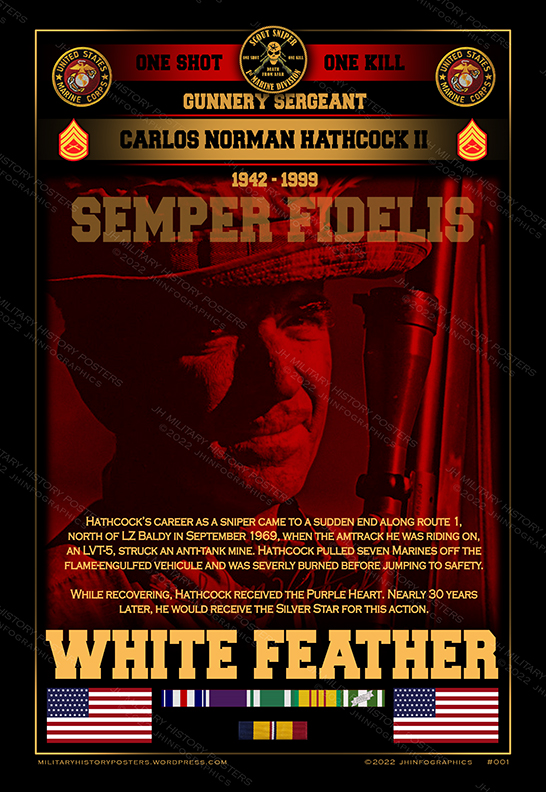
WHITE FEATHER

During the Vietnam War, Gunnery Sergeant Carlos Hathcock had 93 confirmed kills of People’s Army of Vietnam (PAVN) and Viet Cong personnel. In the Vietnam War, kills had to be confirmed by the sniper’s spotter and a third party, who had to be an officer. Snipers often did not have a third party present, making confirmation difficult, especially if the target was behind enemy lines, as was usually the case. Hathcock himself estimated that he had killed between 300 and 400 enemy personnel during the Vietnam War.

The PAVN placed a bounty of US$30,000 on Hathcock’s life for killing so many of its soldiers. Rewards put on U.S. snipers by the PAVN typically ranged from $8 to $2,000. Hathcock held the record for the highest bounty and killed every known Vietnamese marksman who sought him to try to collect it. The Viet Cong and PAVN called Hathcock Lông Trắng, translated as “White Feather”, because of the white feather he kept in a band on his bush hat. After a platoon of Vietnamese snipers was sent to hunt down “White Feather”, many Marines in the same area donned white feathers to deceive the enemy. These Marines were aware of the impact Hathcock’s death would have and took it upon themselves to make themselves targets in order to confuse the counter-snipers.

One of Hathcock’s most famous accomplishments was shooting an enemy sniper through the enemy’s own rifle scope, hitting him in the eye and killing him. Hathcock and John Roland Burke, his spotter, were stalking the enemy sniper in the jungle near Hill 55, the firebase from which Hathcock was operating, southwest of Da Nang. The sniper, known only as the “Cobra,” had already killed several Marines and was believed to have been sent specifically to kill Hathcock. When Hathcock saw a glint (light reflecting off the enemy sniper’s scope) in the bushes, he fired at it, shooting through the scope and killing the sniper. Hathcock took possession of the dead sniper’s rifle, hoping to bring it home as a “trophy”, but after he turned it in and tagged it, it was stolen from the armory.

Hathcock stated in interviews that he killed a female Viet Cong platoon leader called “the Apache woman,” with a reputation for torturing captive U.S. Marines, around the firebase at Hill 55. However scholars such as Jerry Lembcke have cast doubt on Hathcock’s account and questioned the existence of “Apache”.

Hathcock only once removed the white feather from his bush hat while deployed in Vietnam. During a volunteer mission days before the end of his first deployment, he crawled over 1,500 yards of field to shoot a PAVN general. He was not informed of the details of the mission until he accepted it. This effort took four days and three nights without sleep and with constant inch-by-inch crawling. Hathcock said he was almost stepped on as he lay camouflaged with grass and vegetation in a meadow shortly after sunset. At one point he was nearly bitten by a bamboo viper, but had the presence of mind to avoid moving and giving up his position. As the general exited his encampment, Hathcock fired a single shot that struck the general in the chest, killing him.

After this mission, Hathcock returned to the United States in 1967. He missed the Marine Corps, however, and returned to Vietnam in 1969, where he took command of a platoon of snipers.

On September 16, 1969, Hathcock’s career as a sniper came to a sudden end along Highway 1, north of Landing Zone Baldy, when the LVTP-5 he was riding on struck an anti-tank mine. Hathcock pulled seven Marines from the flame-engulfed vehicle, suffering severe burns (some third-degree) to his face, arms, and legs, before someone pulled him away and placed him in water because he was unaware of how badly he had been burnt. While recovering, Hathcock received the Purple Heart. Nearly 30 years later, he received a Silver Star for this action. Hathcock and the seven marines he pulled from the vehicle were evacuated by helicopter to hospital ship USS Repose, then to a naval hospital in Tokyo, and ultimately to the burn center at Brooke Army Medical Center in San Antonio, Texas.