POWs

Click on image to enlarge

Members of the United States armed forces were held as prisoners of war (POWs) in significant numbers during the Vietnam War from 1964 to 1973. Unlike U.S. service members captured in World War II and the Korean War, who were mostly enlisted troops, the overwhelming majority of Vietnam-era POWs were officers, most of them Navy, Air Force, and Marine Corps airmen; a relatively small number of Army enlisted personnel were also captured, as well as one enlisted Navy seaman, Petty Officer Doug Hegdahl, who fell overboard from a naval vessel. Most U.S. prisoners were captured and held in North Vietnam by the People’s Army of Vietnam (PAVN); a much smaller number were captured in the south and held by the Việt Cộng (VC). A handful of U.S. civilians were also held captive during the war.

Thirteen prisons and prison camps were used to house U.S. prisoners in North Vietnam, the most widely known of which was Hỏa Lò Prison (nicknamed the “Hanoi Hilton”). The treatment and ultimate fate of U.S. prisoners of war in Vietnam became a subject of widespread concern in the United States, and hundreds of thousands of Americans wore POW bracelets with the name and capture date of imprisoned U.S. service members.

American POWs in North Vietnam were released in early 1973 as part of Operation Homecoming, the result of diplomatic negotiations concluding U.S. military involvement in Vietnam. On February 12, 1973, the first of 591 U.S. prisoners began to be repatriated, and return flights continued until late March. After Operation Homecoming, the U.S. still listed roughly 1,350 Americans as prisoners of war or missing in action and sought the return of roughly 1,200 Americans reported killed in action, but whose bodies were not recovered. These missing personnel would become the subject of the Vietnam War POW/MIA issue.
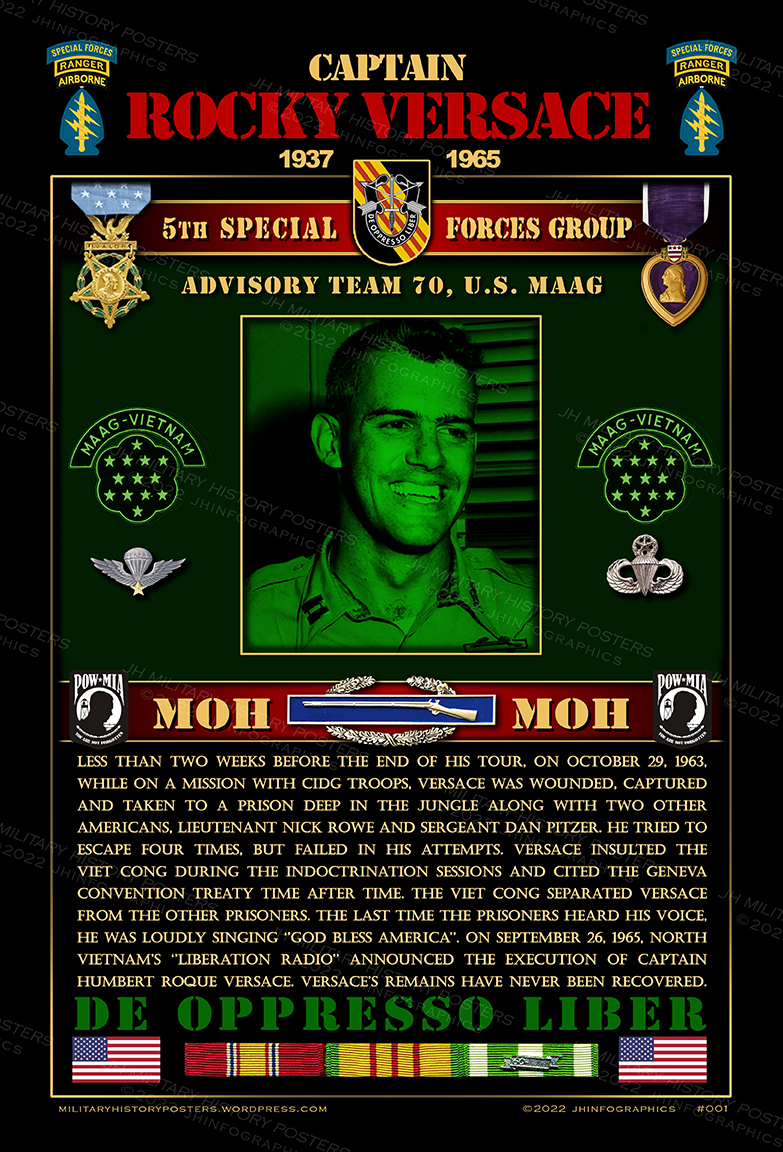
HERO AMONG HEROES

Captain Rocky Versace.

Less than two weeks before the end of his tour, on October 29, 1963, while on a mission with CIDG troops, Captain Versace was wounded,, captured and taken to a prison deep in the jungle along with two other Americans, Lieutenant Nick Rowe and Sergeant Dan Pitzer. He tried to escape four times, but failed in his attempts. Versace insulted the

Viet Cong during the indoctrination sessions and cited the Geneva Convention treaty time after time. The Viet Cong separated Versace from the other prisoners. The last time the prisoners heard his voice, he was loudly singing ‘’God Bless America’’. On September 26, 1965, North Vietnam’s ‘’Liberation Radio’’ announced the execution of Captain Humbert Roque Versace. Versace’s remains have never been recovered.

MOH CITATION

Captain Humbert R. Versace distinguished himself by extraordinary heroism during the period of 29 October 1963 to 26 September 1965 while serving as an S-2 Adviser, Military Assistance Advisory Group, Detachment 52, Ca Mau, Republic of Vietnam. While accompanying a Civilian Irregular Defense Group patrol engaged in combat operations in Thoi Binh District, An Xuyen Province, Captain Versace and the patrol came under sudden and intense mortar, automatic weapons, and small arms fire from elements of a heavily armed enemy battalion. As the battle raged, Captain Versace, although severely wounded in the knee and back by hostile fire, fought valiantly and continued to engaged enemy targets. Weakened by his wounds and fatigued by the fierce firefight, Captain Versace stubbornly resisted capture by the over-powering Viet Cong force with the last full measure of his strength and ammunition. Taken prisoner by the Viet Cong, he exemplified the tenets of the Code of Conduct from the time he entered into Prisoner of War status. Captain Versace assumed command of his fellow American soldiers, scorned the enemy’s exhaustive interrogation and indoctrination efforts, and made three unsuccessful attempts to escape, despite his weakened condition which was brought about by his wounds and the extreme privation and hardships he was forced to endure. During his captivity, Captain Versace was segregated in an isolated prisoner of war cage, manacled in irons for prolonged periods of time, and placed on extremely reduced ration. The enemy was unable to break his indomitable will, his faith in God, and his trust in the United States of America. Captain Versace, an American fighting man who epitomized the principles of his country and the Code of Conduct, was executed by the Viet Cong on 26 September 1965. Captain Versace’s gallant actiona in close contact with an enemy force and unyielding courage and bravery while a prisoner of war are in the highest traditions of the military service and reflect the utmost credit upon himself and the United States Army.