HERO AMONG HEROES

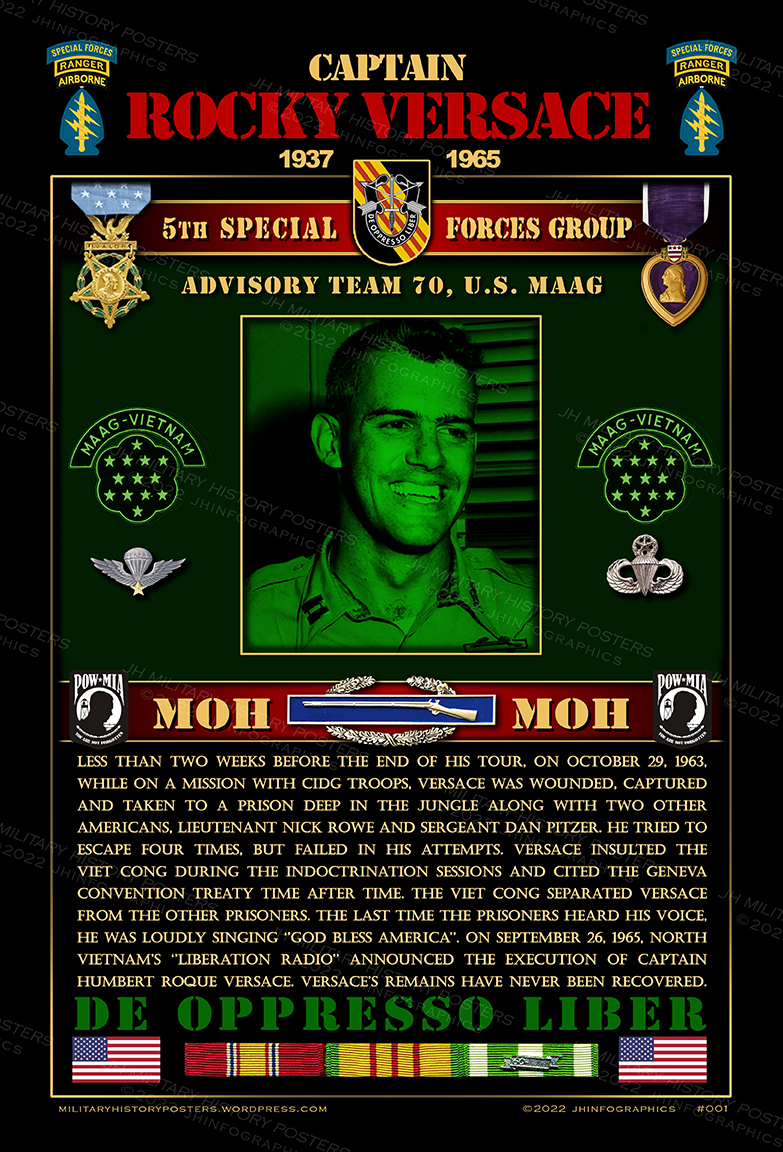
Captain Rocky Versace.

Less than two weeks before the end of his tour, on October 29, 1963, while on a mission with CIDG troops, Captain Versace was wounded,, captured and taken to a prison deep in the jungle along with two other Americans, Lieutenant Nick Rowe and Sergeant Dan Pitzer. He tried to escape four times, but failed in his attempts. Versace insulted the

Viet Cong during the indoctrination sessions and cited the Geneva Convention treaty time after time. The Viet Cong separated Versace from the other prisoners. The last time the prisoners heard his voice, he was loudly singing ‘’God Bless America’’. On September 26, 1965, North Vietnam’s ‘’Liberation Radio’’ announced the execution of Captain Humbert Roque Versace. Versace’s remains have never been recovered.

MOH CITATION

Captain Humbert R. Versace distinguished himself by extraordinary heroism during the period of 29 October 1963 to 26 September 1965 while serving as an S-2 Adviser, Military Assistance Advisory Group, Detachment 52, Ca Mau, Republic of Vietnam. While accompanying a Civilian Irregular Defense Group patrol engaged in combat operations in Thoi Binh District, An Xuyen Province, Captain Versace and the patrol came under sudden and intense mortar, automatic weapons, and small arms fire from elements of a heavily armed enemy battalion. As the battle raged, Captain Versace, although severely wounded in the knee and back by hostile fire, fought valiantly and continued to engaged enemy targets. Weakened by his wounds and fatigued by the fierce firefight, Captain Versace stubbornly resisted capture by the over-powering Viet Cong force with the last full measure of his strength and ammunition. Taken prisoner by the Viet Cong, he exemplified the tenets of the Code of Conduct from the time he entered into Prisoner of War status. Captain Versace assumed command of his fellow American soldiers, scorned the enemy’s exhaustive interrogation and indoctrination efforts, and made three unsuccessful attempts to escape, despite his weakened condition which was brought about by his wounds and the extreme privation and hardships he was forced to endure. During his captivity, Captain Versace was segregated in an isolated prisoner of war cage, manacled in irons for prolonged periods of time, and placed on extremely reduced ration. The enemy was unable to break his indomitable will, his faith in God, and his trust in the United States of America. Captain Versace, an American fighting man who epitomized the principles of his country and the Code of Conduct, was executed by the Viet Cong on 26 September 1965. Captain Versace’s gallant actiona in close contact with an enemy force and unyielding courage and bravery while a prisoner of war are in the highest traditions of the military service and reflect the utmost credit upon himself and the United States Army.

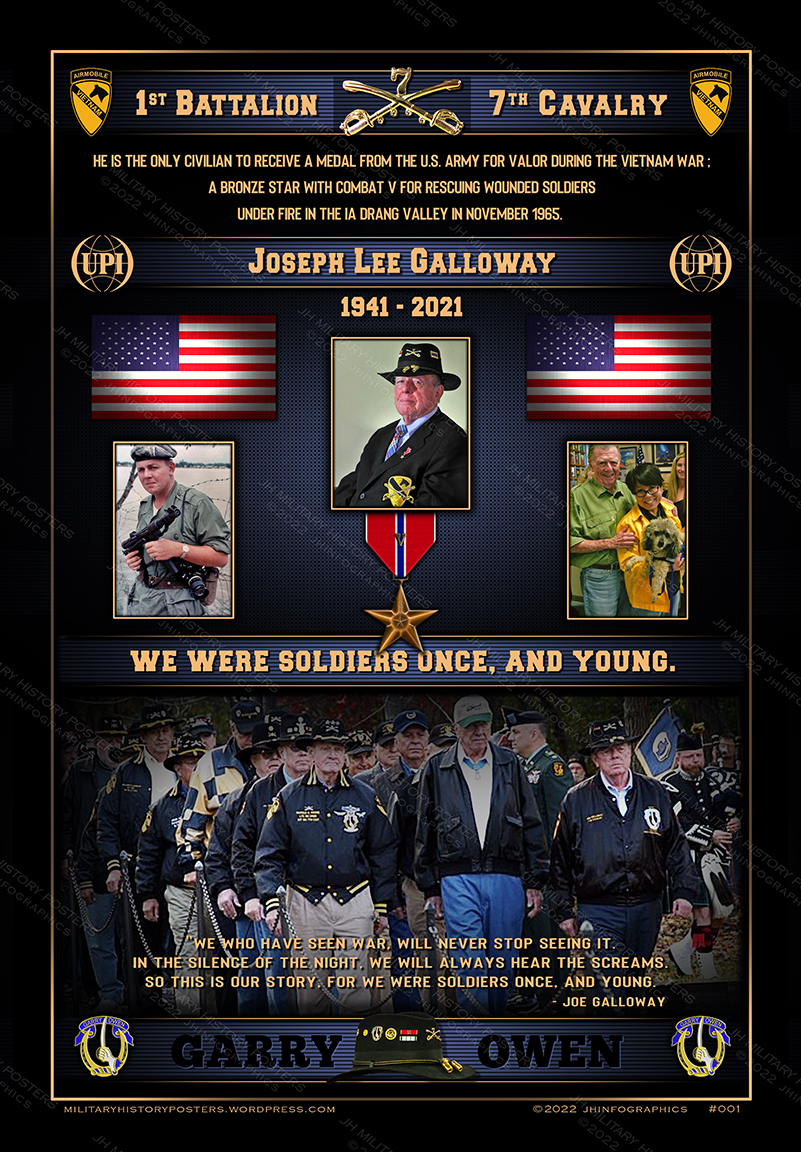
THE GIANT FROM REFUGIO, TEXAS

From a Washington Post obit by Harrison Smith headlined “Joseph Galloway, chronicler and champion of soldiers in Vietnam, dies at 79”:

In November 1965, journalist Joseph L. Galloway hitched a ride on an Army helicopter flying to the Ia Drang Valley, a rugged landscape of red dirt, brown elephant grass and truck-size termite mounds in the Central Highlands of South Vietnam. Stepping off the chopper, he arrived at a battlefield that one Army pilot later called “hell on Earth, for a short period of time.”

Mr. Galloway, a 24-year-old reporter for United Press International, went on to witness and participate in the first major battle of the Vietnam War, in which an outmanned American battalion fought off three North Vietnamese army regiments while taking heavy casualties. He carried an M16 rifle alongside his notebook and cameras, and in the heat of battle, he charged into the fray to pull an Army private out of the flames of a napalm blast.

“At that time and that place, he was a soldier,” Maj. Gen. Joseph K. Kellogg said more than three decades later, when the Army awarded Mr. Galloway the Bronze Star Medal for his efforts to save the private. “He was a soldier in spirit, he was a soldier in actions and he was a soldier in deeds.”

Mr. Galloway later recounted the battle in a best-selling book, “We Were Soldiers Once . . . and Young,” written with retired Lt. Gen. Harold G. Moore, the U.S. battalion commander at Ia Drang. The book was adapted into the movie “We Were Soldiers” starring Mel Gibson as Moore and Barry Pepper as Mr. Galloway, and was acclaimed for its unflinching account of one of the war’s bloodiest battles.

“What I saw and wrote about broke my heart a thousand times, but it also gave me the best and most loyal friends of my life,” Mr. Galloway said in an interview with the Victoria Advocate, the Texas daily where he had once worked as a cub reporter. “The soldiers accepted me as one of them, and I can think of no higher honor.”

Mr. Galloway, whose reporting took him from the jungles of Vietnam to the halls of the Kremlin and the deserts of Iraq, was 79 when he died Aug. 18 at a hospital in Concord, N.C….

In a journalism career that spanned nearly five decades, Mr. Galloway became known for writing elegant, richly detailed stories that immersed readers in conflicts around the world, including the 1971 war between India and Pakistan and the 1991 Persian Gulf War, which he covered while embedded with a tank unit for U.S. News & World Report.

A native Texan who grew up reading the collected reporting of Ernie Pyle, who told the story of World War II through the eyes of ordinary GIs, Mr. Galloway exalted the bravery of American soldiers even as he questioned the wisdom of the leaders who sent them into battle. Gen. H. Norman Schwarzkopf, who led U.S. forces during the Gulf War, once called him “the finest combat correspondent of our generation — a soldiers’ reporter and a soldiers’ friend.”

Mr. Galloway spent 22 years with UPI and retired in 2010 after working as a military affairs correspondent and columnist for the newspaper chains Knight Ridder and McClatchy, where he wrote critically of the Afghanistan and Iraq wars. He was played by Tommy Lee Jones in director Rob Reiner’s movie “Shock and Awe” about Knight Ridder’s skeptical coverage of the George W. Bush administration’s case for invading Iraq.

But he remained best known for his books and articles about Vietnam, most notably “We Were Soldiers Once . . . and Young,” which sold more than 1 million copies. He and Moore spent 10 years researching the volume, interviewing more than 250 people, including Vietnamese military commanders and U.S. veterans and their families.

“It is thoroughly researched, written with equal rations of pride and anguish, and it goes as far as any book yet written toward answering the hoary question of what combat is really like,” author and Vietnam War correspondent Nicholas Proffitt wrote in a review for the New York Times. He went on to call it “a car crash of a book; you are horrified by what you’re seeing, but you can’t take your eyes off it.”

The Battle of Ia Drang began Nov. 14, 1965, after Moore and some 450 soldiers from the 1st Battalion, 7th Cavalry were helicoptered to a clearing known as Landing Zone X-Ray. They were there on a search-and-destroy mission — “It’s probably gonna be a long, hot walk in the sun,” the brigade commander had told Mr. Galloway — and soon came under withering fire.

For the next three days, they struggled to fight off North Vietnamese regulars, sometimes in bloody hand-to-hand combat. Helicopter gunships, fighter-bombers and artillery fire helped turn the tide, although a replacement battalion was ambushed and nearly wiped out while marching to another clearing, Landing Zone Albany, in what Mr. Galloway and Moore described as “the most savage one-day battle of the Vietnam War.”

By the end of the fighting, more than 230 Americans and some 3,000 North Vietnamese were dead at Ia Drang. Both sides claimed victory: North Vietnamese leaders came away certain that they could outlast the Americans, while U.S. commander William Westmoreland was convinced that his troops “could bleed the enemy to death over the long haul,” as Mr. Galloway and Moore put it.

Mr. Galloway, who had arrived on the first night of the battle, said he planned for years to write a book with Moore but had put it off until 1980, when he was flipping channels and came across a Vietnam War sequence in the movie “More American Graffiti,” which brought back memories of Huey helicopters and deafening machine-gun fire.

“I found myself sitting in my chair, shaking like a leaf, with tears rolling down my cheeks at the sight and the memories,” he said in 2017. “I thought, you can run from it, and it will catch you and eat you — or you can face it. I picked up the phone the next morning and called General Moore at his home in Colorado. ‘Are you ready to start work on this book?’ He said, ‘I sure am.’ ”

Few memories of Ia Drang were more painful for Mr. Galloway than the death of Pfc. Jimmy Nakayama, one of two soldiers who were accidentally hit with napalm during a misplaced airstrike on the battle’s second day. Joined by an Army medic who was immediately shot and killed, Mr. Galloway raced toward enemy fire to pull Nakayama from the flames. The private was evacuated but died in a hospital two days later.

After the Pentagon reopened nominations for Vietnam battlefield honors, Mr. Galloway was awarded the Bronze Star Medal in 1998, becoming the fourth American journalist to receive the honor for bravery in the conflict.

“I accept it,” he said at the time, “in memory of the 70-plus reporters and photographers who were killed covering the Vietnam War, trying to tell the truth and keep the country free.”

Joseph Lee Galloway Jr. was born in Bryan, Tex., in 1941, three weeks before the Japanese attack on Pearl Harbor. His father served in the Army during World War II — Mr. Galloway did not meet him until after the war had ended….

Mr. Galloway attended community college for six weeks before dropping out in 1959 to enlist in the Army, which he viewed as a ticket out of South Texas. His mother persuaded him to go into journalism instead, reminding him that as a boy he had written a weekly newspaper for their neighborhood, banging away at a 1912 Remington typewriter.

He joined UPI in 1961 as a reporter in Kansas City, Mo., and within two years he was bureau chief in Topeka, Kan., where he pestered the news agency’s senior editors to send him to Vietnam, sensing from dispatches by Neil Sheehan of UPI and David Halberstam of the Times that conflict there was escalating.

Mr. Galloway got his wish in April 1965, landing in South Vietnam a month after the first American combat troops arrived in the country. He remained there for 16 months and was later UPI bureau chief in Jakarta, the Indonesian capital, and in New Delhi, Singapore, Moscow and Los Angeles.

He later won a National Magazine Award at U.S. News & World Report, for a cover story about the 25th anniversary of the Battle of Ia Drang, and worked as a special consultant to Secretary of State Colin L. Powell before joining Knight Ridder in 2002.

Mr. Galloway’s wife of 29 years, the former Theresa Null, died in 1996. His second marriage — to Karen Metsker, whose father was killed at Ia Drang — ended in divorce, and in 2012 he married Grace Liem Lim Suan Tzu, who worked as a nurse’s helper during the Vietnam War….

Mr. Galloway partnered with Moore on another book, “We Are Soldiers Still” (2008), and teamed with Marvin J. Wolf to write “They Were Soldiers” (2020), about the postwar lives of Vietnam veterans. He also appeared in documentaries such as “The Vietnam War” (2017), directed by Ken Burns and Lynn Novick.

“You do this out of sense of obligation to those who died and those who lived — those especially,” he said in 1993. “Their battle had been forgotten. You just can’t turn your back on something like that, not if you’ve seen it with your own eyes.”
WHITE FEATHER

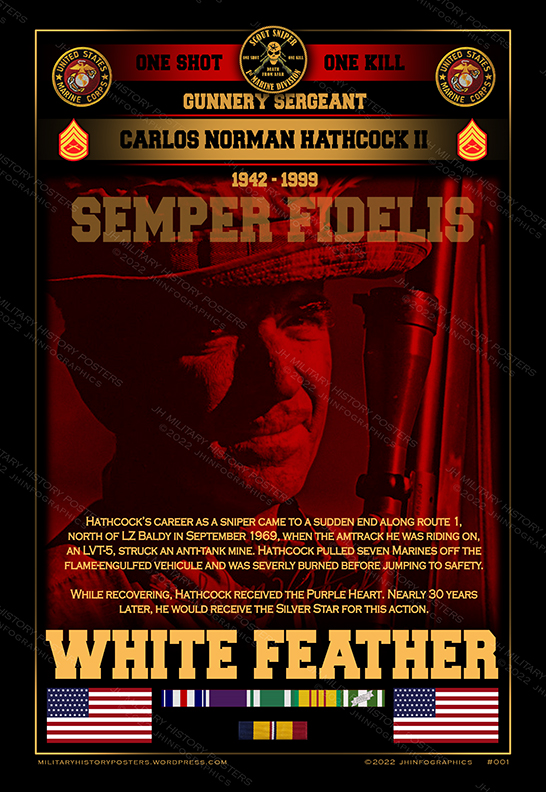
During the Vietnam War, Gunnery Sergeant Carlos Hathcock had 93 confirmed kills of People’s Army of Vietnam (PAVN) and Viet Cong personnel. In the Vietnam War, kills had to be confirmed by the sniper’s spotter and a third party, who had to be an officer. Snipers often did not have a third party present, making confirmation difficult, especially if the target was behind enemy lines, as was usually the case. Hathcock himself estimated that he had killed between 300 and 400 enemy personnel during the Vietnam War.

The PAVN placed a bounty of US$30,000 on Hathcock’s life for killing so many of its soldiers. Rewards put on U.S. snipers by the PAVN typically ranged from $8 to $2,000. Hathcock held the record for the highest bounty and killed every known Vietnamese marksman who sought him to try to collect it. The Viet Cong and PAVN called Hathcock Lông Trắng, translated as “White Feather”, because of the white feather he kept in a band on his bush hat. After a platoon of Vietnamese snipers was sent to hunt down “White Feather”, many Marines in the same area donned white feathers to deceive the enemy. These Marines were aware of the impact Hathcock’s death would have and took it upon themselves to make themselves targets in order to confuse the counter-snipers.

One of Hathcock’s most famous accomplishments was shooting an enemy sniper through the enemy’s own rifle scope, hitting him in the eye and killing him. Hathcock and John Roland Burke, his spotter, were stalking the enemy sniper in the jungle near Hill 55, the firebase from which Hathcock was operating, southwest of Da Nang. The sniper, known only as the “Cobra,” had already killed several Marines and was believed to have been sent specifically to kill Hathcock. When Hathcock saw a glint (light reflecting off the enemy sniper’s scope) in the bushes, he fired at it, shooting through the scope and killing the sniper. Hathcock took possession of the dead sniper’s rifle, hoping to bring it home as a “trophy”, but after he turned it in and tagged it, it was stolen from the armory.

Hathcock stated in interviews that he killed a female Viet Cong platoon leader called “the Apache woman,” with a reputation for torturing captive U.S. Marines, around the firebase at Hill 55. However scholars such as Jerry Lembcke have cast doubt on Hathcock’s account and questioned the existence of “Apache”.

Hathcock only once removed the white feather from his bush hat while deployed in Vietnam. During a volunteer mission days before the end of his first deployment, he crawled over 1,500 yards of field to shoot a PAVN general. He was not informed of the details of the mission until he accepted it. This effort took four days and three nights without sleep and with constant inch-by-inch crawling. Hathcock said he was almost stepped on as he lay camouflaged with grass and vegetation in a meadow shortly after sunset. At one point he was nearly bitten by a bamboo viper, but had the presence of mind to avoid moving and giving up his position. As the general exited his encampment, Hathcock fired a single shot that struck the general in the chest, killing him.

After this mission, Hathcock returned to the United States in 1967. He missed the Marine Corps, however, and returned to Vietnam in 1969, where he took command of a platoon of snipers.

On September 16, 1969, Hathcock’s career as a sniper came to a sudden end along Highway 1, north of Landing Zone Baldy, when the LVTP-5 he was riding on struck an anti-tank mine. Hathcock pulled seven Marines from the flame-engulfed vehicle, suffering severe burns (some third-degree) to his face, arms, and legs, before someone pulled him away and placed him in water because he was unaware of how badly he had been burnt. While recovering, Hathcock received the Purple Heart. Nearly 30 years later, he received a Silver Star for this action. Hathcock and the seven marines he pulled from the vehicle were evacuated by helicopter to hospital ship USS Repose, then to a naval hospital in Tokyo, and ultimately to the burn center at Brooke Army Medical Center in San Antonio, Texas.

TRAGEDY IN THE A SHAU VALLEY

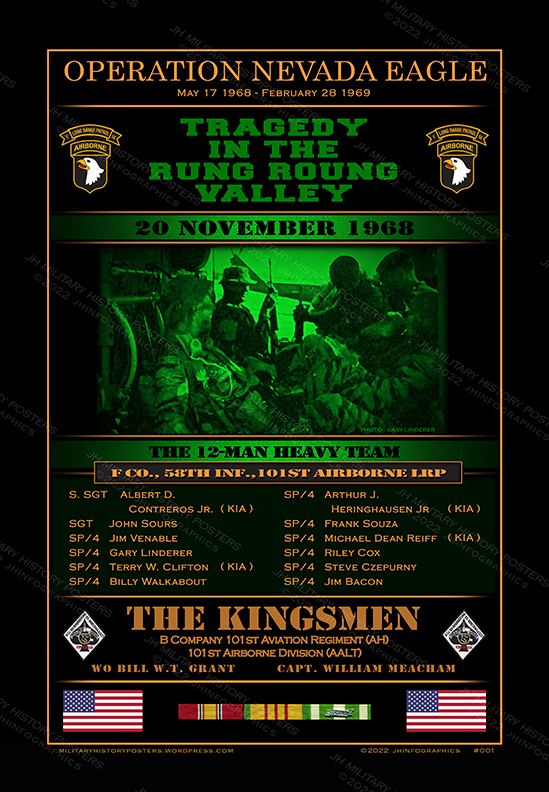
Honoring the Lurps of F Co., 58th Inf., 101st Airborne Division.

50 years ago today tragic events took place during a mission in the Rung Roung Valley. Four brave warriors lost their life that day and everybody else but one team member were gravely wounded. Remembering S.SGT Albert C. Contreros Jr., SP/4 Arthur J. Heringhausen Jr., SP/4 Michael Dean Reiff and SP/4 Terry W. Clifton. May they rest in Peace.

P.S. : I included in the poster the names of the two Kingsmen pilots who risked their life numerous time that day to support and finally extract the team ; Captain William ”Wild Bill” Meacham and Warrant Officer Bill W.T. Grant.

Also I have to mention the courage of all the Lurps of F Co. who answered the call to go to the rescue of their brothers. Some of them only in shorts and Ho Chi Minh sandals !

A story worth to read. If you want to have some titles of books describing this tragic mission, go to our books and films sister page. I will post the covers there later today.

Respect for the Lurps of F Company, 58th Infantry.

MASTER SERGEANT ROY BENAVIDEZ

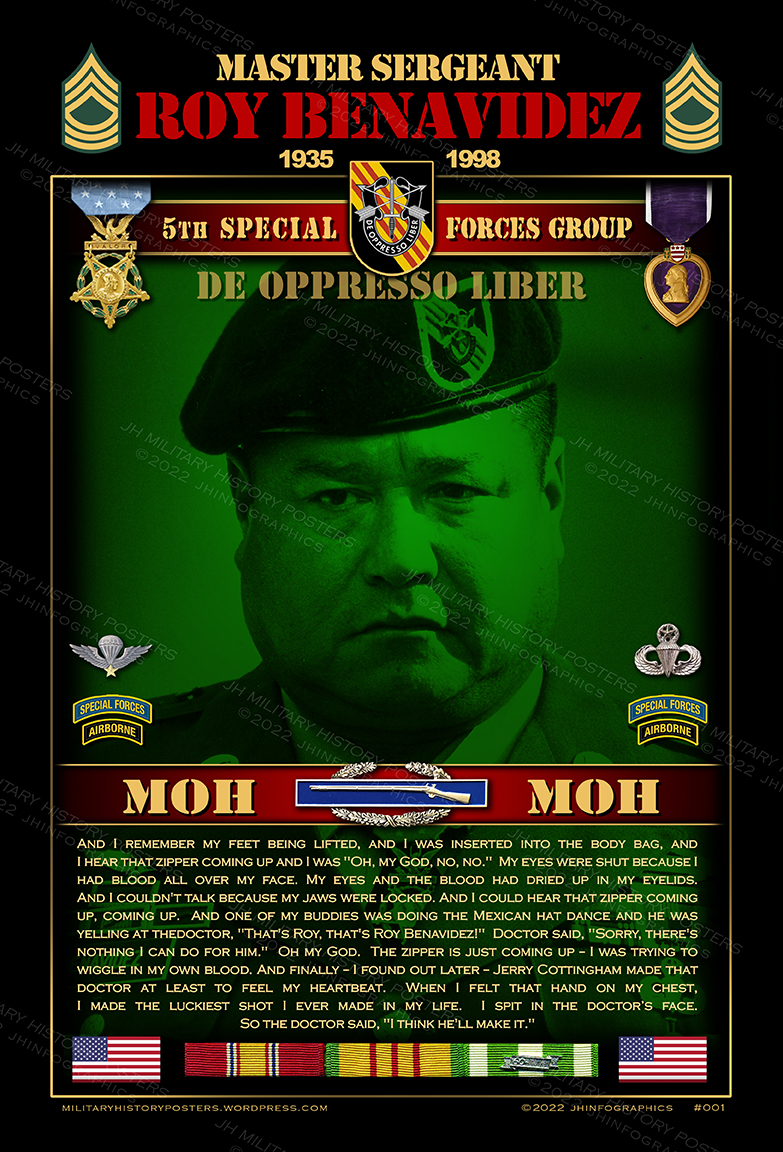
On May 2, 1968, a 12-man Special Forces patrol, which included nine Montagnard tribesmen, was surrounded by an NVA infantry battalion of about 1,000 men. Benavidez heard the radio appeal for help and boarded a helicopter to respond. Armed only with a knife, he jumped from the helicopter carrying his medical bag and ran to help the trapped patrol. Benavidez “distinguished himself by a series of daring and extremely valorous actions… and because of his gallant choice to join voluntarily his comrades who were in critical straits, to expose himself constantly to withering enemy fire, and his refusal to be stopped despite numerous severe wounds, saved the lives of at least eight men.”

At one point in the battle an NVA soldier accosted him and stabbed him with his bayonet. Benavidez pulled it out, drew his own knife, killed him and kept going, leaving his knife in the NVA soldier’s body. He later killed two more NVA soldiers with an AK-47 while providing cover fire for the people boarding the helicopter. After the battle, he was evacuated to the base camp, examined, and thought to be dead. As he was placed in a body bag among the other dead in body bags, he was suddenly recognized by a friend who called for help. A doctor came and examined him but believed Benavidez was dead. The doctor was about to zip up the body bag when Benavidez managed to spit in his face, alerting the doctor that he was alive. Benavidez had a total of 37 separate bullet, bayonet, and shrapnel wounds from the six-hour fight with the enemy battalion.

Benavidez was evacuated once again to Fort Sam Houston’s Brooke Army Medical Center, where he eventually recovered. He received the Distinguished Service Cross for extraordinary heroism and four Purple Hearts. In 1969, he was assigned to Fort Riley, Kansas. In 1972, he was assigned to Fort Sam Houston, Texas where he remained until retirement.

At one point in the battle an NVA soldier accosted him and stabbed him with his bayonet. Benavidez pulled it out, drew his own knife, killed him and kept going, leaving his knife in the NVA soldier’s body. He later killed two more NVA soldiers with an AK-47 while providing cover fire for the people boarding the helicopter. After the battle, he was evacuated to the base camp, examined, and thought to be dead. As he was placed in a body bag among the other dead in body bags, he was suddenly recognized by a friend who called for help. A doctor came and examined him but believed Benavidez was dead. The doctor was about to zip up the body bag when Benavidez managed to spit in his face, alerting the doctor that he was alive. Benavidez had a total of 37 separate bullet, bayonet, and shrapnel wounds from the six-hour fight with the enemy battalion.

Benavidez was evacuated once again to Fort Sam Houston’s Brooke Army Medical Center, where he eventually recovered. He received the Distinguished Service Cross for extraordinary heroism and four Purple Hearts. In 1969, he was assigned to Fort Riley, Kansas. In 1972, he was assigned to Fort Sam Houston, Texas where he remained until retirement.