16 SHOTS – 16 KILLS

click to enlarge

Sgt. Charles “Chuck” Mawhinney spent almost a year and a half in Vietnam, but when he returned home to Oregon in 1969, he kept the details of his service a secret. No one outside a small circle of Marines he served with knew the truth: he was the deadliest sniper in Marine Corps history.

Mawhinney’s story went untold for two decades, but in 1991, friend and former Marine sniper Joseph Ward published a book that credited Mawhinney with 101 confirmed kills, a new record.

Ward’s book triggered an investigation into Marine Corps records, and it was found that the number he reported was incorrect. It turns out that Mawhinney actually had 103 confirmed kills. He also had another 216 “probable” kills.

With the release of Ward’s “Dear Mom: A Sniper’s Vietnam” and the end of Mawhinney’s quiet life of anonymity, this outstanding sharpshooter came out of the shadows and shared parts of his story publicly.

In one particularly intense engagement, Mawhinney put 16 bullets in 16 enemy troops in just thirty seconds, and he did it in the dark.

“I got 16 rounds off that night as fast as I could fire the weapon,” Mawhinney said in an interview for a documentary on Marine scout snipers. “Every one of them were headshots, dead center. I could see the bodies floating down the river.”

Vietnam, as it was for many, was hell for Mawhinney, but he extended his tour of duty because he knew he had the abilities to keep his fellow Marines alive.

One of the things that haunted Mawhinney after Vietnam was an enemy soldier that got away after an armorer had made adjustments to his rifle. He fired off multiple shots. All of them missed.

“It’s one of the few things that bother me about Vietnam,” he previously told The Los Angeles Times. “I can’t help thinking about how many people that he may have killed later, how many of my friends, how many Marines.”

Mawhinney left Vietnam after being diagnosed with combat fatigue. He is still alive, and his M40 rifle is on display in the National Museum of the Marine Corps.

The only US military sniper with more confirmed kills than Mawhinney in Vietnam was Army sharpshooter Adelbert Waldron with 109 confirmed kills.

ANGELS OF THE BATTLEFIELDS

click to enlarge

Like many of the men going over to Vietnam to serve their country, young women from all over the nation volunteered to serve as nurses in the hospitals and medical facilities in South Vietnam. These women volunteered for a variety of reasons: to serve their country, to help the service men who were wounded, to receive training and an education, to further their military careers, to prove themselves or just to have an adventure. The nurses served in the hospital ships of the Navy, the airlift helicopters and airplanes of the Air Force and the hospitals and field hospitals of the Army. They arrived in Vietnam with various levels of nursing experience, from newcomers to the field with barley six months of Nursing under their belts to experienced veterans of twenty plus years. Usually the more confident and experienced the nurse, the better they were able to cope with the stress and the sheer number of casualties they treated on a daily basis.

The Vietnam War was the first major conflict to use the helicopter to transport wounded quickly to medical facilities; sometimes a man would be in the hospital receiving medical care barely half an hour after he had been wounded. This new medevac system saved the lives of thousands of men who in previous conflicts would have died in the battlefield waiting for medical assistance. Because of this phenomenon, Vietnam nurses were faced with more patients and more severely wounded men than they had seen in previous conflicts. These nurses were required to make quick decisions on who was treated first and what type of treatment they would receive; a much more autonomous state than nursing in the states where they were expected to follow a doctor’s orders and nothing more.

Combat nurses worked twelve hour shifts six days a week and when a mass casualty incident occurred, like a major battle, those twelve hour shifts could easily turn into twenty-four to thirty-six hour shifts. Nurses also volunteered their time in the communities around them, often going to the local orphanages or hospitals to offer the civilians their medical services or to teach classes on basic hygiene, first aid or even English. In addition, nurses had to deal with numerous emotions: stress from the amount of patients they had to serve, anger at seeing young men so horribly wounded and guilt at not being able to save all of the wounded men or make them whole again.

Despite the long hours and sometimes horrifying wounds these women had to face, many nurses found their service rewarding. They were able to serve their country and save and comfort the wounded men in their facilities. During the Vietnam War 98% of the men who were wounded and made it to the hospital survived. Nurses witnessed some truly miraculous events such as men recovering from their wounds or acts of true selflessness that are common during combat situations, and many nurses made close friends with their fellow coworkers some of whom still keep in contact into the present day.

NANCY GOES TO VIETNAM

click on image to enlarge

Seductive songs.  Soft sounds.  Sex symbol.  Sinatra.

No, not that one!  Nancy Sinatra.

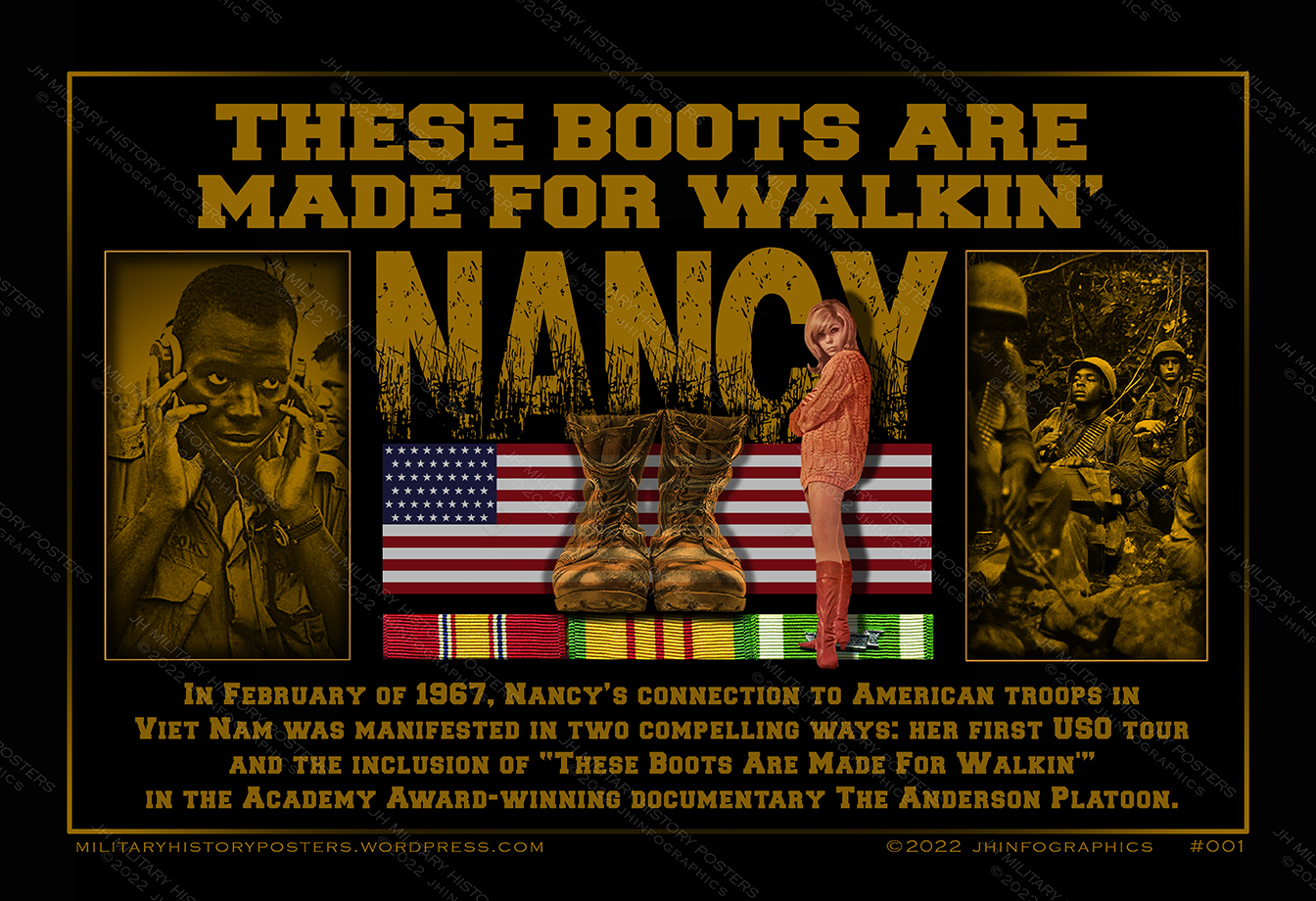
Any discussion of Nancy Sinatra logically begins with the song turned anthem for the women’s lib set.  Undeniably, Nancy Sinatra secured her place in popular culture with her #1 song — These Boots Are Made For Walkin’ in 1966.

She traveled a journey in those boots, before and after her signature song.  It’s a journey worth exploring.

From her only #1 song to her recreation of it two decades on China Beach, an ABC prime time show in the late 1980s and early 1990s set in an American army hospital during the Vietnam War.

From her appearance on the historic 1960 television special Welcome Back, Elvis hosted by her father, Frank Sinatra, to welcome  Elvis Presley back from his two-year stint in the Army to her co-starring position with Elvis nearly a decade later in the 1968 film Speedway.

From the innocent girl who shyly appeared on her father’s television show, The Frank Sinatra Show, to the older and bolder woman who graced the cover of Playboy  in her mid-50s.

Throughout her career, Nancy Sinatra has left some pretty big bootprints on the show business landscape.

These Boots Are Made For Walkin’ spent one glorious week in February 1966 in the #1 position on the popular music chart.  Lee Hazelwood wrote and produced the song, revealing his country & western leanings with the words and the beat, particularly if you eliminate the jazzy horn section.

More than two decades after reaching #1, Nancy Sinatra relived her triumph.  She appeared as herself and sang Boots in the China Beach episode Chao Ong.  It first aired on June 8, 1988 on ABC.  Nancy’s appearance reinforced the show’s verisimilitude.  Stanley Kubrick’s 1987 Vietnam War film Full Metal Jacket featured Boots on its soundtrack.

In real life, Nancy Sinatra performed for American troops in Vietnam, but not before doing some serious soul searching.  An NBC press release dated April 1, 1968 quoted the vivacious singer on this subject.  NBC distributed the press release to promote the repeat broadcast of Ms. Sinatra’s television special Movin’ With Nancy — it aired on NBC on April 15, 1968.  The original broadcast occurred on December 11, 1967.

“I signed up to go on a public appearance tour.  I became frightened and cancelled.  I went home and cried hysterically.  I used yoga to calm myself and analyze my feelings.  I realized that I was suffering because of my decision not to go.  I was sick.  I went to Dad and said ‘I have to go.’  He said, ‘Then let’s work it out.’”

But Nancy Sinatra had a problem beyond second thoughts and cold feet.  Her show needed a lot of rebuilding.

“The show I was going with had fallen apart, which had been part of the problem.  Dad helped me put a new show together.  We missed our place in San Francisco by 30 seconds.  I wondered whether God was trying to tell me something.”

A clergyman saw Nancy and told her, I make that trip twice a month.  You will get much more from it than you will give.

Nancy assimilated her Vietnam War tour into her performances when she returned to the United States.

The March 1, 1967 edition of Variety reviewed a performance on The Ed Sullivan Show, stating, “Of major interest was Nancy Sinatra, who had been making headway in entertainment orbits.  Recently returned from Vietnam, Miss Sinatra showed a feeling as well as a sound in her two-part recital.  In each instance, she was backed by heavy production, the first part was montaged with shots of her GI tour, and the second with honky-tonk atmosphere.  She has enough to get by on her own.”

WHEN I HAVE YOUR WOUNDED

Click to enlarge

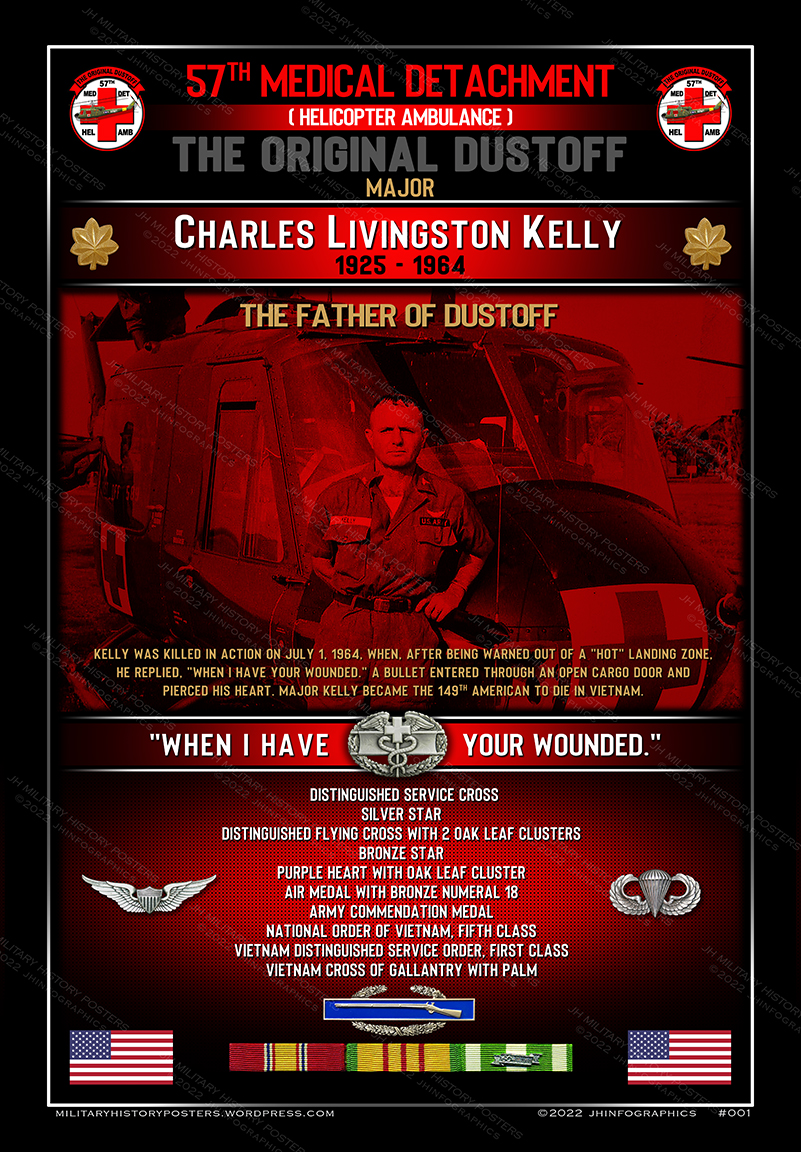
Major Charles L. Kelly was DUSTOFF and DUSTOFF was “Combat Kelly.” The two became synonymous in Vietnam in 1964. As commander of the 57th Medical Detachment (Helicopter Ambulance), Kelly assumed the call sign “DUSTOFF.”

His skill, aplomb, dedication, and daring soon made both famous throughout the Delta. The silence of many an outpost was broken by his radio draw, “…this is DUSTOFF. Just checking in to see if everything is okay.” And when there were wounded, in came Kelly “hell-bent for leather!” On 1 July 1964 Kelly approached a hot area to pick up wounded only to find the enemy waiting with a withering barrage of fire. Advised repeatedly to withdraw, he calmly replied to the ground element’s advisor, “When I have your wounded.” Moments later, he was killed by a single bullet. Kelly was dead but his “DUSTOFF” became the call sign for all aeromedical missions in Vietnam. “When I have your wounded” became the personal and collective credo of the gallant DUSTOFF pilots who followed him. Major Charles L. Kelly was inducted into the DUSTOFF Hall of Fame on 17 February 2001.